Site Meter

Thursday, April 16, 2015

Dear Prudence gives some great advice!

This kind of thing keeps popping up. I wonder how many couples have lived their whole lives without knowing? This is definitely more common than people realize.
Q. Nasty Surprise: When my wife and I met in college, the attraction was immediate, and we quickly became inseparable. We had a number of things in common, we came from the same large metropolitan area, and we both wanted to return there after school, so everything was very natural between us. We married soon after graduation, moved back closer to our families, and had three children by the time we were 30. We were both born to lesbians, she to a couple, and me to a single woman. She had sought out her biological father as soon as she turned 18, as the sperm bank her parents used allowed contact once the children were 18 if both parties consented. I never was interested in learning about that for myself, but she felt we were cheating our future children by not learning everything we could about my past, too. Well, our anniversary is coming up and I decided to go ahead and, as a present to my wife, see if my biological father was interested in contact as well. He was, and even though our parents had used different sperm banks, it appears so did our father, as he is the same person. On the one hand, I love my wife more than I can say, and logically, done is done, we already have children. I have had a vasectomy, so we won't be having any more, so perhaps there is no harm in continuing as we are. But, I can't help but think "This is my sister" every time I look at her now. I haven't said anything to her yet, and I don't know if I should or not. Where do I go from here? I am tempted to burn everything I got from the sperm bank and just try to forget it all, but I'm not sure if I can. Please help me figure out where to go from here.
A: This is a seminal question about the nature of assisted reproduction. As David Plotz discovered in his book, The Genius Factory, on the alleged sperm bank of Nobel Prize winners, many non-geniuses were moved to spread their seed far and wide. So the question has always hung over this: What if the offspring meet and fall in love? Well, you've met and it's true that if you had researched your origins and disclosed them to each other, you and your wife would now likely be close half-siblings. I understand your desire to burn everything. But if you are now looking at your wife and thinking, "Hey, sis," I don't see how you can keep this information to yourself. She's bound to sense something off in your behavior and you simply can't say, "I'm struggling with father issues." I think you have to sit her down and show you what you've discovered. Then you two should likely seek out a counselor who deals with reproductive technology to help you sort through your emotions. I don't see why your healthy children should ever be informed of this. That Dad didn't want to find out who his sperm donor was is a sufficient answer when they get old enough to ask about this. I think there's way too much emphasis put on DNA. Yes, you two will have had a shock, but when it wears off you will be the same people you were before you found out. Shocking news has the effect of making people feel as if the waves it sends out will always rock them. But I think you two should be able to file away your genetic origins and go on.
This is one of those cases where I really like Prudence. This is great advice. Don't lie, but don't act like things have to be different just because of this information. What's done is done, and it's understandable. No reason to let the past ruin the present.

I also really like this: "I think there's way too much emphasis put on DNA. Yes, you two will have had a shock, but when it wears off you will be the same people you were before you found out." Righteous.

Wednesday, April 15, 2015

Polyamorous role models in the media


More positive coverage of real polyamorous relationships in the media! Yay! This article is a really good summary of the history and future of legal polyamory in the US and Canada.

Can you be fired for being polyamorous?

A recent case from Australia says "yes":
You won’t be surprised to know that the word “poly” comes from the Greek word “polýs” which means ‘many’.  But did you know that, earlier this year, the Federal Circuit Court of Australia in Bunning v Centacare [2015] FCCA 280 was faced with the question of whether an employee of a religious organisation could be dismissed for being “polyamorous”?   (Defined by the Oxford Dictionary to be “the practice of engaging in multiple sexual relationships with the consent of all involved.”)
Susan Bunning was employed by Centacare (a Catholic counselling organization) in the position of Clinical Practice Co-ordinator.  In 2011 or 2012 Ms Bunning became associated with the Brisbane Poly Group (a social group for those interested in open relationships and polyamory) and provided the organisation with her work contact details which were later published on their website.
About a year later Centacare dismissed Ms Bunning for serious misconduct when it became aware of her involvement with the Brisbane Poly Group. It argued that her involvement was against the moral teachings of the Catholic Church and brought Centacare into disrepute. Ms Bunning lodged a claim with the Federal Circuit Court alleging unlawful discrimination under the Sex Discrimination Act 1984 (SDA). While the SDA makes it unlawful to discriminate against an individual because of their sexual orientation, the key question for the court was whether being polyamorous was a relevant sexual orientation.
To Ms Bunning’s disappointment, the court held that it had no jurisdiction to hear her claim because, for the purposes of the SDA, the phrase “sexual orientation” was intended to mean “how one is” rather than a person’s sexual behavior or lifestyle.  The court said that, if polyamory could be considered a person’s sexual orientation, this would potentially lead to the absurd result where sexual behaviors such as pedophilia and necrophilia would be legally protected grounds.
In light of this decision, it seems that although a person’s sexual behavior would not be protected by anti-discrimination laws in Australia, sacking an employee for having friends with benefits could still get employers in hot water under other legal routes such as a claim for unfair dismissal or adverse action.
Poly people have had to deal with this for a long time. Polyamory still doesn’t have anything close to general acknowledgement, let alone acceptance, and there are no workplace protections for polyamorous people.

The judge's argument is ridiculous. I agree that polyamory generally is no less a lifestyle than monogamy, but firing someone for being monogamous would in many situations justify damages due to wrongful termination. We need to ask ourselves whether we're okay with the increasing creep of employers to punish people for their private behavior. If firing someone for wearing a green shirt when there's no official dress policy is wrongful termination, then why should someone's private romantic endeavors be any less protected when they're even more important to a person's identity and quality of life?

I think firing her because she used her work information for an organization they don’t agree with is more valid than firing her for purely private actions. That said, they cited her membership in the Brisbane Poly Group itself as their grounds for firing her, which would still be illegal under any reasonable workplace protection scheme.

Edit: A follower on Tumblr gave their own personal experience.
Bee got fired from his job a few years ago when they found out about our relationship. This shouldn’t be happening to poly (and, LGBT) people - but it does. Even the workplace protect[ion] laws here in Canada are weak enough that for some of the time things like this happen. Which is why we fight hard here, and work with the CPAA (Canadian Polyamory Advocacy Association - under pseudonyms, unfortunately). Sharing her work details shouldn’t have been enough to fire her. If they didn’t want the workplace associated, they could of had it taken down.
Just because there are enclaves of acceptance, and just because there's been some positive media attention lately, doesn't mean that poly people aren't still (potentially unlawful) pariahs in mainstream society. This is why organizations like the CPAA are so important.

Tuesday, April 14, 2015

"I'm poly and happy—do I have to come out?"

Dan Savage gets a question:
His response:
Not everyone who's poly can be out, NUNYA, just as not everyone who's gay, bi, trans, kinky, or poz can be out. But the only way to dispel myths about poly people and poly relationships—poly people are all burners, poly relationships don't work out for the long term, all nonmonogamous relationships ultimately fail—is for poly people to come out when and where they can. So if you're in a position to be out, NUNYA, you should come out.
And while your poly relationship isn't anyone's business, it's not something you should have to hide, either.

"Theories on the Origin of Sexual Orientation, 1864-present"

I've found a very good aggregation of the various theories of the origin of homosexual attraction.
1896 -- Published in a German pamphlet, "Sappho and Socrates," which describes the origin of homosexuality as taking place in a bisexual embryo.
Hirschfeld posited the existence, in the embryos of both sexes, of rudimentary neural centers for attraction to both males and females. In most male fetuses, the center for attraction to women developed, while the center for attraction to males regressed, and vice versa for female fetuses. In fetuses destined to become homosexual, on the other hand, the opposite developmental sequence took place.
While admitting that the location of these centers was still unknown, Hirschfeld predicted that when they were identified, it would be found that adults of each sex carried the vestigial remnants of the centers typical for the other sex.
I wouldn't be surprised if that turned out to be true.
1978 -- [E.O. Wilson] hypothesized a possible genetic predisposition for homosexuality in certain humans by using a theory he calls 'inclusive fitness,' defined as the sum of the individual's reproductive successes plus the reproductive success of others who carry that person's genes. He explained that there are homosexual genes that exist not only in the individual who is homosexual but in his relatives. Homosexual persons contributed to the survival of the family by not having children so they were available to support and help other family members, by serving in roles such as aunt, uncle, shaman, or medicine man. Thus, genes for homosexual orientation increased in frequency, not because they aided the homosexual person in his or her own survival but because they aided the relatives who shared his gene pool. This broader spread of the genes helps explain how persons with the homosexual genes could be reproduced, since they themselves often did not produce offspring.
It may also just be an ameliorating side-effect.
2012 -- [...] For several years, studies led by Andrea Camperio Ciani at the University of Padova in Italy and others have found that mothers and maternal aunts of gay men tend to have significantly more offspring than the maternal relatives of straight men...
[...] The theory holds that the same genetic factors that induce gayness in males also promote fecundity (high reproductive success) in those males' female maternal relatives. Through this trade-off, the maternal relatives' 'gay man genes,' though they aren't expressed as such, tend to get passed to future generations in spite of their tendency to make their male inheritors gay...

[...] Turns out, the moms and aunts of gay men have an advantage over the moms and aunts of straight men for several reasons: They are more fertile, displaying fewer gynecological disorders or complications during pregnancy; they are more extroverted, as well as funnier, happier and more relaxed; and they have fewer family problems and social anxieties.
Unfortunately, there is no such breadth of reasonable neurological and biological theories for consanguinamory. Only GSA is understood, and even then I think scientists assume more understanding than they actually have. I suspect there are many unexamined subtleties in "normal" human attraction and the Westermarck Effect.

Sunday, April 12, 2015

You Can Still Be Arested for Being Gay

It's not something most people are aware of, but given how recently it was still constitutional to ban sodomy, it's not that surprising.
Last week, the Advocate reported some troubling news out of Louisiana: Since 2011, at least a dozen men have been arrested on a count of “attempted crimes against nature”—that is, an offer to have sex with another man. Even worse, the arrests were part of a sting operation in which undercover officers propositioned men, lured them into an apartment, then promptly arrested them and brought them to jail. The latest arrest occurred on July 18.
Sound retro? It is and it isn’t. On the one hand, Louisiana’s actions are patently, almost comically unconstitutional. It’s been a decade since the U.S. Supreme Court ruled in Lawrence v. Texas that “the liberty protected by the Constitution allows homosexual persons the right ... [of] intimate conduct with another person.” That 6–3 ruling struck down every anti-sodomy law in the country, legalizing homosexuality—as well as any kind of sexual contact between consenting adults, gay or straight.
On the other hand, rejecting Lawrence has long been in vogue in red states. Ten years after Lawrence, 13 states, all of them red or red-leaning, have kept their anti-sodomy laws on the books. And three of them—Kansas, Oklahoma, and Texas—explicitly outlaw consenting sex between people of the same sex. In much of red-state America, then, being gay remains officially illegal.
If these laws lingered as unenforced, outdated relics, they might not be such a big deal. Sure, anti-sodomy statutes present a significant affront to the “personal dignity and autonomy” Justice Anthony Kennedy wrote about in Lawrence, but plenty of obsolete state laws remain on the books long after their expiration dates. Yet these laws aren’t merely symbolic. Same-sex couples in North Carolina and Texas have been arrested for “homosexuality conduct” in recent years. And as the Louisiana debacle illustrates, overzealous law enforcement officers feel enabled by the law to arrest, prosecute, and generally humiliate gay people simply for being gay.
The continuing presence of anti-sodomy laws can’t be blamed on absentminded legislators, either. Equality advocates have mounted significant efforts in all 13 states to repeal these laws in the wake of Lawrence—efforts that failed in the face of conservative resistance. In Virginia, the endeavor actually backfired: An attempt to revoke the state’s “crimes against nature” statute led the legislature to reaffirm the anti-sodomy law—more than a year after Lawrence.
Virginia’s law has returned to the spotlight in recent months as Ken Cuccinelli, the state’s current attorney general, has centered his gubernatorial campaign on an effort to enforce Virginia’s Crimes Against Nature law. Cuccinelli was integral to the defeat of the 2004 repeal bill, and nearly a decade later, he remains strangely fixated on an issue settled long ago by the highest court in the land. He’s even prosecuted a case based on the state’s anti-sodomy laws, all the while insisting that his efforts are directed against all forms of sodomy, not just same-sex intimacy. (Never mind that the would-be governor is on the record describing “homosexual acts” as “intrinsically wrong” and “not healthy.”)
There’s no easy legal remedy for these holdout states. The Supreme Court can render state laws unenforceable, but they can’t officially remove them from the books. And though lower courts consistently shoot down attempts to revive anti-sodomy laws, reactionary politicians and homophobic police chiefs will almost certainly continue to use these laws to intimidate and denigrate gay citizens. A decade after the Supreme Court found that matters of sexual intimacy are “central to the personal dignity and autonomy” guaranteed by the Constitution, too much of red-state America still formally outlaws homosexuality. And there doesn’t seem to be anything anybody can do about it.
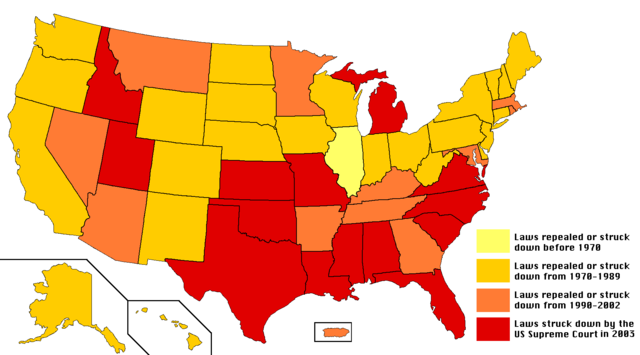
This is a map of current anti-sodomy laws in the US, all of which are unconstitutional. (The map is slightly out of date, since Montana repealed its law.)
Remember, these laws were only ruled unconstitutional about a decade ago. A generation ago, half of the country still outlawed sodomy. There are people alive today whose relationships were against the law where they lived for most of their lives. Here is a map of the repeals of sodomy laws. Notice how many didn’t repeal their laws until the 1990s.

Even if laws are frequently waved, and few to no prosecutions actually result, and the use of the laws are erratic, laws which outlaw consensual sex between adults are dangerous and repressive. If a man has a gun pointed at your head, even if he doesn’t fire it, even if you know he probably won’t fire it, even if shooting you is technically illegal, the mere presence of that gun is traumatizing and oppressive. It changes how you think and behave.
Given how recently this was relevant to so many LGBT+ people across the US, you’d think there’d be more awareness and sympathy among the community for other groups who face this reality daily, but recently there’s been a lot of progress for the LGBT+ community socially and legally, and people have surprisingly short memories.

"Mountain Gorillas and Inbreeding: The Path to Extinction or Salvation?"

A recent analysis of the mountain gorilla genome has revealed something important:
Mountain gorillas are currently suffering from a serious inbreeding problem, and while scientists everywhere worry that this will lead them down the path to extinction, one new genetic study says that it might in fact be their salvation. This is the first study ever to sequence whole genomes from mountain gorillas, and it is helping shed light on the impact of population decline on these critically endangered apes.
Back in 1981, the number of mountain gorillas living in the Virunga volcanic mountain range - on the borders of Rwanda, Uganda and the Democratic Republic of Congo - plummeted to a mere 253 apes, thanks to habitat loss and hunting. Since then, conservationists have been working to restore their population, boosting their numbers to approximately 480 among the Virunga population.
However, while this is certainly an improvement, these mountain gorillas are not out of the woods yet. Scientists are concerned that severe inbreeding among this small population is causing decreased genetic diversity and threatening their very survival. But now, researchers are saying that many harmful genetic variations had in fact been removed from the population through inbreeding, and that mountain gorillas are genetically adapting to surviving in small populations.
"This new understanding of genetic diversity and demographic history among gorilla populations provides us with valuable insight into how apes and humans, their closely related cousins, adapt genetically to living in small populations," said Dr. Aylwyn Scally, corresponding author from the Department of Genetics at the University of Cambridge. "In these data we can observe the process by which genomes are purged of severely deleterious mutations by a small population size."
In the study, published in the journal Science, researchers were able to sequence the whole genomes of seven mountain gorillas for the first time using blood samples collected over several years. Previously, only poor-quality DNA from fecal and hair samples was available. This time around, scientists were able to compare the genomes of all four gorilla subspecies. They found that these mountain gorillas - along with eastern lowland gorillas, their closely related neighbors - were two to three times less genetically diverse than gorillas from larger groups in western regions of central Africa. What's more amazing is that mountain gorillas have managed to survive in small populations for thousands of years.
It has long been a concern that for a species that is already critically endangered, severe inbreeding would push them more towards extinction - that is, with low level of genetic diversity making them more vulnerable to environmental change and disease, including cross-infectious strains of human viruses. However, that does not appear to be the case. The inbreeding has, in some ways, been genetically beneficial. For example, fewer harmful loss-of-function variants were found in the mountain gorilla population than in the more numerous western gorilla populations. These variants stop genes from working and can cause serious, often fatal, health conditions.
"We worried that the dramatic decline in the 1980s would be catastrophic for mountain gorillas in the long term, but our genetic analyses suggest that gorillas have been coping with small population sizes for thousands of years," concluded Dr. Yali Xue, first author from the Sanger Institute. "While comparable levels of inbreeding contributed to the extinction of our relatives the Neanderthals, mountain gorillas may be more resilient. There is no reason why they should not flourish for thousands of years to come."
That aside about Neanderthals is conjecture. Anyway, this is something people have been saying here and there for a while, but this is the first hard evidence showing it to be the case. Because mountain gorillas have had smallish, isolated populations for most of their history due to the terrain, they’ve had to deal with a higher than average level of endogamy than other species. The combination of gene mixing between populations and gene isolation within populations, ensured that harmful recessive genes would be eliminated faster from the gene pool, and that this process wouldn’t destroy the population as a whole. As a result, when humans started driving them to near extinction, their gene pool was already adapted to deal with high levels of mating among close genetic relatives. (This happened to cheetahs as well.) This means that the sparsely populated mountain gorillas are actually more likely to survive human destruction and poaching than their cousins at sea level.

So is endogamy good or bad? It depends. Like most things in life, it depends.

Sunday, April 5, 2015

This really sums it up

On a recent episode of SciShow about gender, Hank Green made a really important point:
Science is not necessarily necessary in this situation, because I feel like sometimes, if you feel a way, and you want to live your life a way, science doesn't need to be a part of that, but there is, I think, some affirmation and some freedom in knowing that nature is complicated, and that all these things can actually be reflected in our scientific understanding of gender, and sex, and sexuality.
I think this idea applies generally. Everybody is so obsessed with “naturalness”, but why does it even matter? We’re diverse and live in an artificial environment. What should matter in people’s life choices is whether those choices are good for them and those around them, if they can be most fulfilled by living that way. I think individuals are in a better position to determine what is most fulfilling for themselves, not institutions. Our norms and institutions should be to help people exist well together and live fulfilling lives, not to destroy people.

Thursday, April 2, 2015

Bigotted "Help" Just Causes Harm

From the comments of Full Marriage Equality:
Sounds a lot like what I was told when I went looking for advice though I don't know if that was the particular place I got it or not. Essentially I was told to not to make any moves, just wait and eventually my feelings would go away as if it was just a phase. I was also pretty much told to be silent with regards to my condition. I actually complied, because it wasn't like I really had much of a choice. I mean, adults face 25 years where I live, and while I am sure a minor would face less, I don't know how much. There was also the social stigma, to which I was already acquainted with from when I was even younger.
But let me tell you one thing, that advice was useless, and basically amounts to bottling up your feelings and throwing them under the bus. Their support was even worse, because after hearing them I felt even more alone than I had before. Everybody was out for themselves, all of their advice was basically to maintain the status quo of doing nothing, I was even told that it would be detrimental to tell anybody, which it could very well have been but many who might not want to go through with it would probably do a lot better if their family understood and was willing to help them. Such advice may have in fact isolated me and many others from help we need, either in regards to avoiding going through with it, or to actually go through with in as a minimally damaging way possible. Even worse, if somebody is looking for a way out then telling them there is no way out and you're basically f**ked regardless, and the only thing you can do is wait and pray your heart gives up on them, can you really call that advice? Can you really call that support? How is anybody suppose to get help when the helpers are just as condemning and demonizing as everybody else.
Either they hated themselves and it showed through their writing, or they were inexperienced in the area masquerading their trolling as advice. I felt that had they just told me that I was better off dead that it wouldn't have changed their antagonism much towards me (yes it felt as if they had something against me as a person rather than toward my question).
Around ten years later, and my feelings haven't "gone away" they weren't just a phase, instead they have grown. My silence and and being alone in my struggle had a dramatic negative effect on my life. For several years I struggled with my depression. The past couple of years and especially the past few months I decided to discard my silence. Even if I stay anonymous, speaking out has helped me tremendously. I've found people that have supported me(though not personally due to anonymity), and I don't feel anywhere near as alone as before. By the same token, there have been people that have judged me (same as before, not personally due to anonymity), but I can see that their inexperience with the subject has clouded their judgment, their bigotry has lost most of it's power. Those that support tend to have had experience with consanguinamory, or knows somebody who has, and they learned that the arguments are inconsistent hogwash, while the bigots only have hear say of cases where not all facts are known and bias is presented. Everything else if filled out with ignorance.
If anybody is reading this, know that whether you pursue a relationship with a relative, or you choose to avoid it, there are people that respect and support your choice. It's all about environment. I've been to both good and bad sites, and the good sites, I've stayed at, the bad ones I don't visit anymore or avoid as much as possible. This has taught me that there is more than one choice for environment, if you seek help and they tell you rubbish, there are other places that are far more helpful. You'll know a good environment is one you don't fear speaking in.

Why we need legal reform

Some friends of Full Marriage Equality discuss the threats they have to navigate:
You can read about Bonnie and her fiancé here. The woman (Anonymous) who starts the conversation is married to a man who happens to be here genetic father. Like Bonnie, this is a Genetic Sexual Attraction situation, meaning these men did not raise these women. These women were strongly attracted to the men in their lives and are happy with them.
[...] Anonymous: So one of my old high school friends is starting to figure out [my husband in my genetic father.] Now I'm worried about her reaction to it. Bonnie: My grandfather is doing the same. It's so annoying cause you want to tell them but you don't how they're going to react. Or if they really are figuring it out.

Anonymous: Exactly

Bonnie: My dad says that grandpa is picking on me like he used to his girlfriends. We are so confused.

Anonymous: Well she has been my friend for 9 years now, and I have wanted to tell her but couldn’t because of fright.

Bonnie: Yes, I understand.

Anonymous: I want her to figure it out so she will ask me about it.

Bonnie: Yes that's what we did with our one and only friend, other than our roommate, who knows. I think it's the best way because people who don't wanna know or are afraid to know usually do not ask so you know it's most likely the time you can admit it.

Anonymous: She keeps telling me to tell her what is going on and she will be open minded, but I still don't know.

Bonnie: Just wait until she asks. It's going to be safer in my opinion.

Anonymous: Well, my adopted family knows and hates me for it. They are trying to get our kids now and everything.
[...] Can you imagine going through things like this simply because of loving another adult?
In all honesty, as sad a truth as it is, if her family really wants to take her children away, they'll succeed - 100%. Not only is the law no safeguard for her, but it's actually the primary threat they could use to blackmail her into giving the children willingly.